
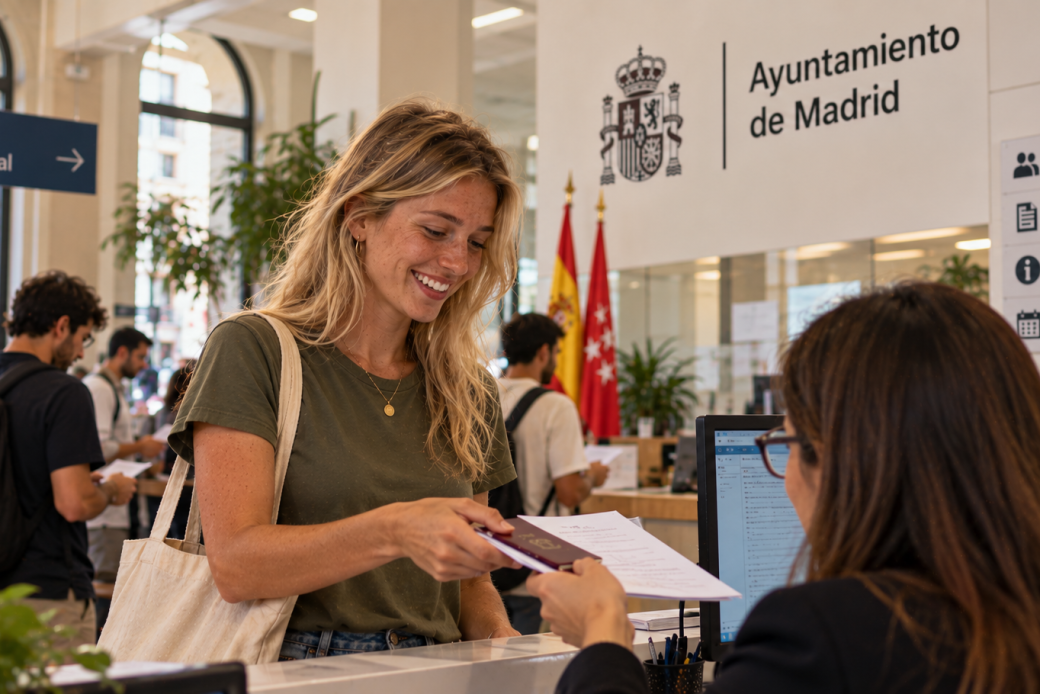
If you live in Spain, you must register in the padrón municipal of the town or city where you usually live. In English, this process is often described as municipal registration or address registration. You will generally need a registration form, a valid identity document and proof that you live at the address. The exact documents and appointment system depend on your local ayuntamiento, or city council.
The most important point is simple: empadronamiento confirms where you live, but it does not grant legal residence, an immigration permit or the right to work. It is separate from your passport, visa, NIE and TIE. If you live in more than one municipality, you should register where you spend the most time during the year.
Are you wondering whether you can register without a NIE or without a rental contract? In many cases, yes. What matters is proving your identity and your actual residence through a document or authorization accepted by the municipality. This guide explains what empadronamiento in Spain is, who needs it, which documents to prepare and how the registration process works.
What is empadronamiento in Spain?
The padrón municipal is the administrative register of people who live in a municipality. Its records provide evidence of your habitual residence and address for administrative purposes. The technical instructions published in the Official State Gazette establish the national framework, while each ayuntamiento manages registrations in its own municipality.
Every person who lives habitually in Spain must register in the municipality where they live. If you divide your time between several places, register where you spend the most time each year. Registering in a new municipality normally replaces a previous padrón registration elsewhere.
Your padrón registration may help you:
- Access certain municipal or regional services.
- Provide an address for healthcare, education, social-services or immigration procedures when required.
- Apply for support or benefits whose conditions include living in a specific municipality.
- Show how long you have lived at an address when an administration requests it.
The padrón does not replace a visa, residence authorization, NIE, TIE or work permit. It also does not regularize an immigration situation. The Spanish legal framework for the municipal register separates proof of address from the documents that establish your immigration status.
Who needs to register in the Spanish padrón?
Anyone who habitually lives in Spain should register in the municipality where they reside. Nationality does not remove that obligation, and you do not need to wait until you have completed every other immigration procedure.
EU, EEA and Swiss citizens
You can usually identify yourself with a valid passport or national identity card. If you already have a foreigner registration certificate with a NIE, your ayuntamiento may ask for it as part of the file. The padrón is still a separate municipal registration from EU residence registration.
Non-EU citizens
You can usually identify yourself with a valid passport or a TIE, depending on your circumstances and the documents accepted by the municipality. A residence permit and padrón registration serve different purposes: one relates to your immigration status, while the other records your address in a municipality.
People without a NIE
A NIE is not a universal requirement for padrón registration. Depending on your nationality and situation, your passport or national identity document may be enough to prove who you are. Confirm the exact identification document with the ayuntamiento where you live.
People who rent a room or live with someone else
You can still register if the lease is not in your name. The municipality may accept a room contract, an authorization from the person who holds the lease or owns the home, or another document showing that you actually live there.
What is the difference between a volante and a padrón certificate?
Both documents show information from the padrón, but they serve different purposes. Before requesting one, check which format the organization or administration handling your procedure requires.
| Document | What it usually does | When it may be useful |
| Volante de empadronamiento | Informs you of the address and registration details held by the municipality | Routine administrative requests and everyday procedures |
| Certificado de empadronamiento | Formally certifies your residence and address as a public administrative document | Immigration, nationality, family, court or other procedures that expressly request certification |
The padrón certificate in Spain may be requested when an administration needs formal proof rather than an information notice. A volante may be enough for a routine procedure, but the receiving organization decides what it accepts. If the request says “certificado,” ask specifically for a certificado de empadronamiento, not only a volante.
Documents needed for padrón registration in Spain
There is no single document list that works identically in every municipality. The national instructions give the common framework, but your ayuntamiento can specify its own forms, appointment requirements, document formats and proof of address.
| Part of the application | Documents commonly accepted | What to confirm locally |
| Registration form | Municipal padrón form or hoja padronal, signed by the people being registered | Whether every adult must sign and whether the municipality provides its own form |
| Identity | Passport, national ID card, EU registration document or TIE, depending on your situation | Whether the document must be valid and what to provide if it has expired |
| Address | Current lease, property deed, room agreement or authorization from another occupant | Whether recent bills, owner details or a municipal authorization form are also required |
| Representation | Signed authorization and identity documents for both people | Whether the ayuntamiento has its own authorization template |
| Minors | Birth certificate, family record book or equivalent document | Whether parental authorization, custody documents or official translations are needed |
Take the originals or the copies specified by the ayuntamiento. If you use documents issued outside Spain, confirm whether they need an official Spanish translation, apostille or legalization.
Identity documents by nationality
EU, EEA and Swiss citizens can generally identify themselves with a valid passport or national identity card. A foreigner registration certificate may also be relevant if you already have one.
For people from outside the EU, the usual identity documents are a valid passport or a TIE. If a document has expired, the municipality may ask for evidence that you have applied for its renewal. Confirm the accepted combination before your appointment.
Documents that prove your address
The goal is to show that you actually live at the address, not necessarily that you own the property. Depending on the local process, the ayuntamiento may accept:
- A current rental contract.
- A property deed or other document showing ownership.
- A room-rental agreement.
- Written authorization from the property owner, main tenant or person legally occupying the home.
- Documentation from a residence, shelter or other collective accommodation.
- An alternative procedure through municipal social services if you do not have a fixed address.
Some municipalities ask for a recent utility bill, information from the property owner or an inspection. Do not prepare your file using a checklist from a different city: the municipality where you live controls the final document requirements.
How to register in the padrón, step by step
The process is usually straightforward when your identity and address documents match the local requirements. Follow this order so you know what to prepare before you request an appointment or submit the application online.
1. Find your ayuntamiento’s official procedure
Search the city council website for “alta en el padrón,” “alta por cambio de residencia” or “municipal registration.” Check whether the process is in person, online or available by mail, and whether you need an appointment.
Online submission is only available when the municipality offers it. It may require an approved electronic identification system or digital certificate. The Spanish public administration portal can help you locate official services, but the local ayuntamiento remains the final reference for the procedure.
2. Prepare the exact documents
Complete the padrón form, prepare your identity document and collect the proof of address accepted by your municipality. Add any authorization, representation or family documents that apply to your situation.
If a document comes from another country, check the translation, apostille or legalization requirements before your appointment. Preparing this step carefully gives you a complete file from the beginning.
3. Submit the application
Present the application through the channel offered by the ayuntamiento. Keep the registration receipt, appointment confirmation or online submission number. You may need it later when you request a volante de empadronamiento or a padrón certificate.
4. Respond to a possible verification request
The municipality can check the information you provide by requesting additional documents, carrying out an address verification or using a report from the Policía Local. The purpose is to confirm your identity and actual residence at the address.
If the ayuntamiento asks for more information, follow the instructions and deadline shown in the notification. A complete response helps the municipality finish the registration with the correct details.
5. Request the document you need after registration
Once the registration is complete, request a volante for ordinary procedures or a certificate when a formal process requires one. Check your name, address and registration date as soon as you receive the document.
When the municipality can register you directly from the documents provided, the registration is effective from that point and cannot normally be backdated. If the ayuntamiento needs to investigate the address or request additional information, the general administrative period can extend up to three months under the current technical instructions.
Can you register without a rental contract?
Yes. Not having a lease in your own name does not automatically prevent padrón registration. You still need to show that you habitually live at the address through the route accepted by your municipality.
If you live in someone else’s home
The person who owns the property, holds the rental contract or is already registered there may need to authorize your registration. The ayuntamiento can request that person’s identity document, proof of their connection to the home and a municipal authorization form.
If you rent a room
A room agreement can be useful when it identifies the property, the parties and the period of the arrangement. Some municipalities may also request authorization from the main tenant or property owner, especially when the room agreement does not cover the full property.
If you live in a residence or collective accommodation
The person responsible for the residence, shelter or other collective accommodation may be able to authorize registration under the local procedure. Confirm which document the center must provide before you book your appointment.
If you do not have a fixed address
The municipal register also considers people who habitually live in a municipality without a conventional fixed address. A domicilio ficticio, or administrative address, may be possible through the relevant social-services procedure and supporting report. Contact the municipality’s social-services department to understand the route for your circumstances.
Registering children and families
When you register a minor, the ayuntamiento may need to confirm identity, family relationship and who has legal representation. The documents depend on whether both parents apply, one parent applies alone or a legal guardian acts for the child.
The municipality may request a birth certificate, family record book, authorization from the other parent, a custody agreement or a court decision. Foreign documents may need an official translation, apostille or legalization. If your family is moving together, check the documents for each person before requesting the appointment.
When do you need to update or renew your padrón registration?
The action you need depends on your nationality, residence status and whether your address changes.
| Situation | What you should do |
| You move within the same municipality | Report the new address through the local padrón procedure |
| You move to another municipality in Spain | Register in the new municipality; it normally manages the previous registration change |
| You are a non-EU citizen without long-term residence | Renew the registration every two years through an express confirmation |
| You are an EU, EEA or Swiss citizen, a family member under the EU regime or a long-term resident | There is no biennial renewal, although the municipality may request periodic confirmation of residence |
| You leave Spain permanently | Check the deregistration procedure that applies to your situation |
Keep your address and contact details updated. If you are a non-EU citizen without long-term residence, mark the two-year renewal date in your calendar so the padrón registration in Spain continues to reflect where you live.
Checklist for empadronamiento in Spain
Use this checklist alongside the instructions published by your ayuntamiento:
- I have confirmed the municipality where I usually live.
- I have found the official registration procedure and know whether I need an appointment.
- I have completed and signed the municipal registration form.
- My passport, identity card or TIE is valid, or I have checked the accepted renewal documents.
- I have proof of address accepted by this specific ayuntamiento.
- I have prepared an authorization if the property or lease is in another person’s name.
- I have included any representation or minor-related documents required.
- I have checked whether foreign documents need translation, apostille or legalization.
- I will keep the submission receipt or application number.
- I know whether I need a volante or a formal padrón certificate after registration.
- I know whether my nationality and residence status require renewal every two years.
After empadronamiento: connect the registration to your wider move
Empadronamiento is one part of settling into Spain. If you are moving for remote work, keep your municipal registration separate from your immigration route. WanderPad’s English guide to Spain’s digital nomad visa explains the international teleworker route, while the guide to the best places to live in Spain can help you compare destinations before choosing a municipality.
Once you have an address and a working routine, the social side matters too. The WanderPad app lets you create a profile, connect with communities and discover work-friendly spaces. You can also find practical relocation and remote-living content through the WanderPad English blog.
FAQs about empadronamiento in Spain
Can a foreigner register in Spain without a NIE?
Yes. A NIE is not a universal requirement for empadronamiento. Depending on your nationality and circumstances, a valid passport or national identity document may be enough to prove your identity. Your ayuntamiento confirms the exact document combination it accepts.
Can I register in Spain without a rental contract?
Yes. You may be able to use an authorization from the person who owns or rents the home, a room-rental agreement, documentation from collective accommodation or another proof accepted by the municipality. The key point is showing that you actually live at the address.
Does empadronamiento prove legal residence in Spain?
No. Empadronamiento confirms your habitual address for municipal and administrative purposes. It does not prove that your immigration status is legal, regularize your situation or give you permission to work. Keep your padrón documents separate from your visa, residence authorization, NIE and TIE.
What is the difference between a volante and a padrón certificate?
A volante usually provides information about your padrón details and may be enough for routine procedures. A padrón certificate in Spain formally certifies your residence and address and is used when an administration expressly requests a certificate. Check the required format before requesting the document.
How often must a foreigner renew their padrón registration?
Non-EU citizens without long-term residence generally need to renew their registration every two years through an express confirmation. EU, EEA and Swiss citizens, family members under the EU regime and long-term residents do not follow that biennial renewal, although the municipality may request periodic confirmation.
Make empadronamiento your first practical step in Spain
The padrón turns your new address into an official administrative reference, helping you organize the next parts of your life in Spain with more clarity. Start with the municipality where you actually live, check its current requirements and prepare your identity and address documents together.
The exact process varies by ayuntamiento, so use this guide as a clear starting point and verify the final checklist locally. This article was reviewed in October 2026; municipal procedures, forms and document requirements can change. It is an informational guide, not individual immigration or legal advice.