
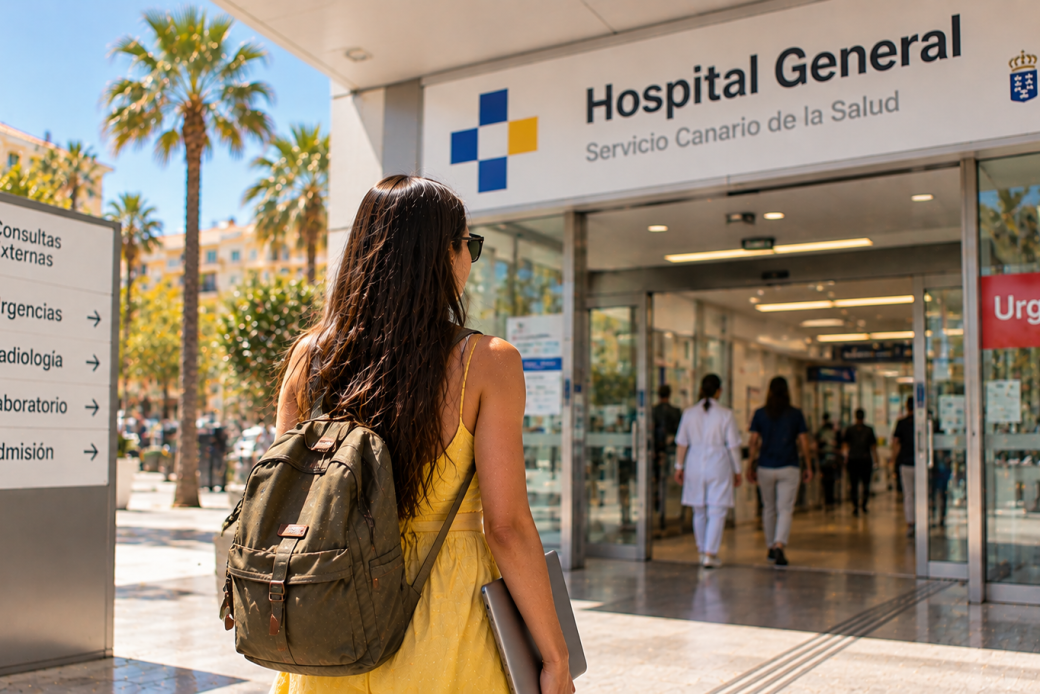
Yes, foreigners can access healthcare in Spain, but the right route depends on your situation and on the country or institution responsible for your coverage. If you work and contribute to Spanish Social Security, you may use the public system once your entitlement is recognized. If you are visiting from Europe, an EHIC/TSE or an equivalent document can cover medically necessary public care during a temporary stay. If another country remains responsible while you live in Spain, the S1 form may be the right option. Other situations may involve a regional public-health procedure, a special agreement or private insurance.
The most important distinction is simple: an identification document is not the same as proof of healthcare entitlement. An NIE or empadronamiento can form part of your paperwork, but neither one alone gives you a Spanish health card.
Are you visiting, working or settling here? Start with the situation that most closely matches your plans, then use the checklist below to confirm your next step.
Healthcare in Spain for foreigners: which route applies to you?
When people search for Spain healthcare for foreigners or healthcare in Spain for expats, they are usually trying to identify one practical thing: which system will cover them during their stay. In practice, your access depends on how you are insured, how long you plan to stay and whether Spain or another country is responsible for paying for your care.
| Your situation | Usual route | First step |
|---|---|---|
| You are employed or self-employed in Spain | Public healthcare through Spanish Social Security, once your entitlement is recognized | Check your healthcare entitlement, then request the health card through your autonomous community |
| You are the dependent of someone insured in Spain | Beneficiary status within the public system | Apply for recognition as a beneficiary through the INSS before requesting the card |
| You are visiting Spain temporarily from the EU/EEA, Switzerland or the UK | EHIC/TSE, a UK GHIC or another valid document issued by your country | Use a public provider and present the relevant card or certificate |
| You live in Spain while another European country remains responsible for your coverage | S1 form | Register the S1 with Spanish Social Security and then follow the regional health-card process |
| Your residence route requires private medical insurance | A policy that meets the conditions of your authorization | Check the required level of coverage, exclusions, validity and payment terms before choosing a policy |
| You habitually live in Spain without legal residence and have no other route to coverage | Recognition under Royal Decree 180/2026 | Apply through the health authority in your autonomous community with proof of identity and habitual residence |
| You have lived in Spain for at least one year and do not qualify through another public route | Convenio especial, or special agreement | Check the requirements and application channel of the autonomous community where you are registered |
| You are a child, pregnant, seeking international protection or covered by another special rule | Specific public-health rules | Contact the relevant health authority so your case is assessed under the correct procedure |
| You are visiting from a country outside these coordination systems | Travel or private medical insurance, a bilateral agreement or another recognized payer | Confirm who will cover treatment before relying on the Spanish public system |
This is a useful starting map, not a substitute for checking your individual case. Before cancelling insurance, booking a medical appointment or assuming that care is covered, confirm which institution recognizes your entitlement.
NIE, empadronamiento and the Spanish health card are different things
These documents often appear together when you settle in Spain, but each one answers a different administrative question. Understanding the distinction can make the process much easier.
| Document | What it proves | What it does not prove |
|---|---|---|
| NIE | Your foreigner identification number in Spain | That you have legal residence, Spanish Social Security coverage or public healthcare |
| TIE or EU registration certificate | Your residence status, depending on your situation | That your healthcare entitlement has already been recognized |
| Empadronamiento | That you are registered at an address in a municipality | Legal residence or automatic access to the Spanish National Health System |
| Provisional entitlement document | That a healthcare application or recognized right can be used temporarily in the relevant circumstances | Your identity or every type of healthcare coverage |
| Individual health card (TSI) | Your identification when accessing the Spanish National Health System | Private insurance or treatment outside the system’s applicable rules |
The NIE is an identification number, while the empadronamiento is a municipal registration. The Spanish health card is issued after a competent authority has recognized your right to public healthcare. Keeping these roles separate will help you prepare the right documents for each appointment.
How to access public healthcare and request your health card
The exact process varies by autonomous community, but the decision usually follows three practical steps. Think of it as proving who you are, which route applies to you and where you live.
1. Confirm which institution recognizes your entitlement
If you are employed or self-employed in Spain, start by checking that your Social Security registration and healthcare entitlement are active. If you are applying as a family member, beneficiary recognition usually comes first. In other cases, the regional health service may be the authority that processes your application.
The key question is not only “Where is my nearest health center?” but also “Which document proves that this health system is responsible for my care?” Once you have that answer, the health-card process becomes much clearer.
2. Prepare a complete document folder
The documents depend on your route, but you may need:
- Passport or official identity document.
- NIE, TIE or EU registration certificate, where relevant.
- Proof of recognized healthcare entitlement.
- Current empadronamiento or another accepted proof of habitual residence.
- Proof of family relationship when applying as a beneficiary.
- EHIC/TSE, UK GHIC, S1 or another certificate when another country is involved.
- Proof of employment or Social Security registration, if applicable.
- A responsible declaration and supporting documents for a Royal Decree 180/2026 application.
Check the requirements of your autonomous community before you travel to an office or health center. Some regions use online appointments, specific forms or different channels for the initial application.
3. Complete the regional health-card process
Once your entitlement has been recognized, apply for the individual health card through the relevant autonomous-community health service. The Ministry of Health explains that the Tarjeta Sanitaria Individual (TSI) is the official document used to identify people when they access services in the Spanish National Health System. It is issued by the autonomous health administrations or INGESA to people whose public entitlement has been accredited.
Keep any provisional document with you while the physical or digital card is being issued. The card is connected to the public system, so it is separate from your private insurer’s membership card.
EHIC/TSE or S1: which document fits your stay?
Both documents coordinate healthcare between European systems, but they are designed for different situations. A useful question is: are you temporarily visiting Spain, or has Spain become your place of residence?
Use an EHIC/TSE or equivalent for a temporary stay
The European Health Insurance Card (EHIC), known in Spain as the TSE, allows eligible visitors to receive medically necessary public healthcare during a temporary stay in the European Economic Area or Switzerland, under the same conditions that apply to people insured in the country of stay. Depending on the issuing country, you may use a UK GHIC, an EHIC or a provisional replacement certificate.
The card is not designed to replace a long-term Spanish healthcare arrangement. It does not cover private treatment, planned treatment undertaken specifically to receive care abroad or repatriation. Some services may also involve the same patient contribution that applies to locally insured people.
The official guidance on the European Health Insurance Card explains how temporary stays work and when a provisional certificate may be used.
Use an S1 when another country remains responsible
The S1 can be relevant when you live in Spain but remain insured under the system of another country, for example in certain pension, cross-border or posted-worker situations. It is issued by the institution responsible for your healthcare in that country.
After receiving the form, you generally need to register it with Spanish Social Security and then follow the local process for accessing healthcare and obtaining the relevant health card. The official Social Security service for registering an S1 in Spain lists the documentation for the Spanish registration step.
An S1 is not a replacement for a residence permit, and an EHIC is not a substitute for a long-term arrangement. Matching the document to the way you live in Spain is the most helpful first decision.
Ways to arrange healthcare coverage in Spain
If your Spanish public entitlement is still being arranged, there are several routes to explore. The right option depends on your residence status, habitual address, previous coverage and whether another person or country is responsible for the cost.
Public healthcare recognition for habitual residence
Royal Decree 180/2026 sets out the procedure for certain foreigners who are in Spain without legal residence and who do not have another route to publicly funded healthcare. The conditions include:
- You are not required to prove mandatory healthcare coverage through another route.
- You cannot export healthcare coverage from your country of origin or previous country of insurance.
- There is no third party legally responsible for paying for your care.
The process focuses on proving your identity and habitual residence in Spain. A current empadronamiento certificate is one accepted form of evidence; the rules also list alternatives such as certain education, social-service, consular or household-bill documents.
The application is handled through the relevant autonomous-community health authority. The Spanish Ministry of Health’s public-access guidance explains the requirements and documents, while the text of Royal Decree 180/2026 provides the legal framework.
One particularly useful detail is that the administration should provide provisional proof when the application is submitted with the required documentation. This can allow access to publicly funded care while the case is being resolved, subject to the applicable procedure.
Children, pregnant people, international-protection applicants, people with temporary protection and other specially protected groups can follow specific rules. If one of these situations applies to you, mention it when you contact the health service.
Convenio especial: a paid public-health route
The convenio especial is a public-health agreement for people who do not qualify as insured or beneficiaries through another route. The basic requirements include:
- At least one continuous year of effective residence in Spain immediately before applying.
- Registration in a municipality within the territory of the competent authority.
- No access to public healthcare through Spanish law, European coordination rules or a bilateral agreement.
The standard monthly fee set by the national framework is €60 for people under 65 and €157 for people aged 65 or older. Autonomous communities may add complementary services or apply their own administrative instructions, so confirm the current terms locally.
The agreement provides access to the basic common package of services. It is not identical to a private insurance policy, and contributions may still apply to medicines or certain services under the applicable rules. The consolidated BOE text for the convenio especial sets out the requirements and fees.
Private health insurance in Spain for expats
Private healthcare in Spain for expats can be useful when your residence route requires a policy, when you are between public systems or when you prefer private providers for certain appointments. It is a separate route from Spanish public entitlement, so compare the policy with the specific purpose for which you need it.
Before choosing a policy, check:
| What to compare | Why it matters |
|---|---|
| Coverage certificate and policy wording | The document may need to meet specific residence or administrative requirements |
| Primary care and hospital care | Some policies focus on one area or use different provider networks |
| Waiting periods and pre-existing conditions | These can affect when particular services become available |
| Copays, deductibles and exclusions | A low monthly price can come with higher costs at the point of care |
| Direct billing and reimbursement | The process can differ between clinics and insurers |
| Policy duration and renewal | Your coverage needs to match the length and conditions of your stay |
| Language and customer support | Clear communication helps when arranging appointments or documents |
If you are using insurance to support a residence application, verify the current requirement for that specific authorization. Keep the policy active until your new healthcare route is fully confirmed.
Getting medical care while your paperwork is being arranged
You can prepare the administrative side and the practical side at the same time. If you need urgent medical help, call 112: the number is free from fixed and mobile phones throughout the European Union and connects you with emergency services.
For non-urgent care, contact the health service in the autonomous community where you are staying and take every document that may help establish your situation:
- Passport, NIE, TIE or other identity document.
- EHIC/TSE, UK GHIC or provisional certificate.
- Registered S1 or proof of Spanish Social Security entitlement.
- Private insurance policy and assistance number.
- Provisional healthcare document or application receipt.
- Previous medical reports and current prescriptions.
If your coverage route has not yet been confirmed, ask who will be responsible for the appointment before non-urgent treatment begins. Keep reports, prescriptions, receipts and invoices so you can use them in any later reimbursement or registration process.
Details worth checking before you apply
The process becomes easier when you turn the most common points of confusion into a short checklist:
- Identify your healthcare route before focusing on the card. The card follows recognized entitlement; it does not create it.
- Use the document that matches your stay. An EHIC/TSE is intended for temporary visits, while an S1 may fit a residence where another country remains responsible.
- Keep your identity and residence documents separate. An NIE identifies you, and the empadronamiento supports your municipal address; neither one alone proves public coverage.
- Check the autonomous-community process. Forms, offices and appointment systems can vary across Spain.
- Keep private insurance active until the next route is confirmed. This is especially important when a residence authorization has its own insurance conditions.
- Ask whether another country or person remains responsible for payment. That answer can change the correct application route.
- Save every confirmation. A receipt, provisional document or official resolution can be useful when you request the health card or arrange care.
Once healthcare is clear, make settling in easier
Healthcare is one of the practical foundations of a new life in Spain. Once you know which route applies to you, you can give more attention to the people, places and routines that make a destination feel like home.
If you are still deciding where to base yourself, the guide to the best places to live in Spain for remote workers compares cities by rent, lifestyle, connectivity and everyday routine. When you arrive, WanderPad’s app can help you discover communities, chat with other remote professionals and find people who are already building a life in your city.
The WanderPad verified spaces add another practical point of connection: a place to work, meet people and create a familiar weekly rhythm. A smooth arrival is built from small, clear steps, and healthcare is an important one to understand early.
Sources and review date
This article was reviewed on October 8, 2026, using information from the Spanish Ministry of Health, the Spanish Social Security system, the Official State Gazette, the Spanish public administration portal and Your Europe.
Healthcare access depends on your nationality, insurance history, residence status, autonomous community and the reason for your stay. Check the current official requirements before starting a procedure, cancelling a policy or assuming that a treatment will be covered.
Frequently asked questions about healthcare in Spain for foreigners
Do all foreigners have the right to public healthcare in Spain?
Not automatically. Access may come through Spanish employment or Social Security, beneficiary status, an EHIC/TSE for a temporary stay, an S1, a regional recognition procedure, a convenio especial or another specific rule. The correct route depends on your circumstances and on who is responsible for your coverage.
Does an NIE entitle me to a Spanish health card?
No. The NIE is an identification number, not proof of public healthcare entitlement. You still need a recognized route to coverage and must complete the health-card process through the competent authority.
Can I use an EHIC to live in Spain?
The EHIC/TSE is designed for medically necessary public care during a temporary stay. If Spain becomes your place of residence, check whether an S1, Spanish Social Security, a regional public-health procedure or qualifying private insurance is the appropriate route.
How does a foreigner who works in Spain get a health card?
First, check that your employment or self-employment has created recognized healthcare entitlement through Spanish Social Security. Then complete the application with the health service of your autonomous community, providing your identity documents and proof of entitlement.
What if I need a doctor before my coverage is active?
For an emergency, call 112. For non-urgent care, contact the relevant regional health service and bring every document connected with your situation. If the responsible payer has not been confirmed, ask about the payment route before treatment and keep all medical records and receipts.