
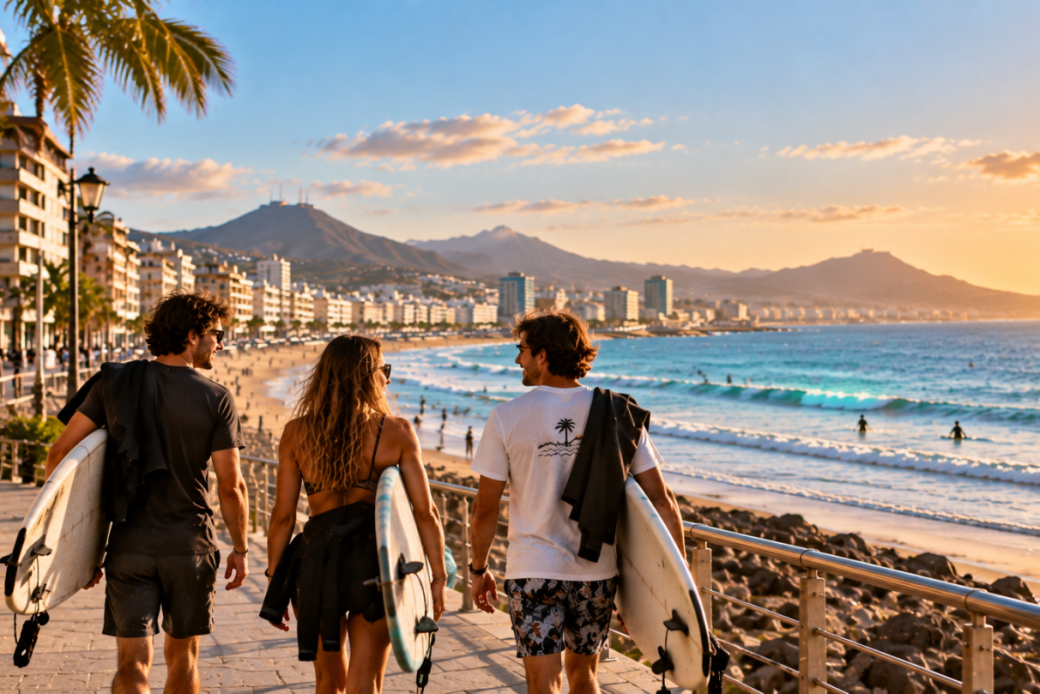
The best areas to live in Gran Canaria depend on what you want to make effortless. Las Canteras and Guanarteme are the strongest all-round choice for a first stay without a car. Maspalomas suits a sunnier, outdoor-led routine, Telde gives your housing budget more room, and Agaete trades convenience for nature and calm.
This guide compares rent pressure, walkability, social momentum and car dependence. WanderPad’s broader Gran Canaria remote-work guide covers monthly planning and connectivity.
Best areas to live in Gran Canaria at a glance
Start with the inconvenience you are least willing to accept. A beautiful apartment loses its appeal quickly if every coffee, meeting or grocery run requires planning.
| Area | Best for | Budget signal | Car need | Main compromise |
| Las Canteras and Guanarteme | First stays, beach life and social connection | High for Las Palmas | Low | Demand, noise and smaller homes near the sea |
| Vegueta, Triana and central Las Palmas | Culture, city services and practical transport | Medium within the capital | Low | The beach is no longer part of every daily walk |
| Maspalomas and Meloneras | Sunshine, outdoor time and comfort | High | Medium | Seasonal pressure and a less compact routine |
| Playa del Inglés and San Fernando | International energy with everyday services | Medium-high to high | Low to medium | Atmosphere varies sharply from one street to another |
| Arguineguín and Patalavaca | A settled southwest coast | High | Medium | Limited supply and some steep streets |
| Telde and the east coast | Local life, airport access and better value | Lower among current benchmarks | Medium | Fewer spontaneous remote-work connections |
| Arucas, Agaete and the north | Green surroundings, calm and nature | Variable | High | Smaller rental supply and more planned journeys |
Shortest answer: choose Las Palmas for balance, the south for reliable outdoor living, Telde for value, or the north and northwest for space and a slower rhythm.
Las Palmas: the easiest first base without a car
Las Palmas de Gran Canaria concentrates the island’s widest mix of services, work settings and social possibilities. It is the safest shortlist when you are arriving alone or do not yet know how much you will explore.
Las Canteras and Guanarteme for the complete first-month setup
Choose this area when you want beach, errands, exercise and opportunities to meet people within the same daily radius. Las Canteras provides the promenade and urban beach; Guanarteme adds residential streets, surf culture and everyday businesses. Demand is the trade-off: Puerto-Canteras had the capital’s highest district asking-rent benchmark in September 2026. Check the exact street for evening noise.
Vegueta and Triana for culture and city life
Vegueta and Triana work better when historic streets, restaurants and culture matter more than waking beside the beach. San Telmo adds useful interurban connections. Their September 2026 rent benchmark sat below Puerto-Canteras, but this is a different lifestyle rather than a cheaper copy. For a more functional middle ground, Alcaravaneras and Arenales simplify cross-city journeys.
South and southwest Gran Canaria: sun over city convenience
The south makes sense when weather and outdoor time drive the move. The official Gran Canaria tourism site explains how mountains and trade winds create microclimates, with drier, sunnier conditions along the southern coast.
Maspalomas and Meloneras for comfort and outdoor routines
Maspalomas is the strongest southern option if walks, sport and evenings outside should shape the week. Meloneras feels polished and resort-oriented; Campo Internacional is lower-rise; Sonnenland can provide more space but is easier with a car. Check the exact walk to groceries, transport and your work setting, because “Maspalomas” is not one compact neighborhood. San Bartolomé de Tirajana also carries one of the island’s higher rent signals.
Playa del Inglés and San Fernando for a more practical south
Playa del Inglés brings international activity and flexible accommodation. San Fernando adds large supermarkets, gyms and a more residential rhythm. Street choice matters: a lively location can help you meet people and frustrate sleep or calls. Visit in the evening and confirm that a temporary rental covers your full stay.
Arguineguín and Patalavaca for a lived-in coastal base
Arguineguín feels more like a working coastal town than a resort complex. Its port, shops and established international population create a settled routine. Patalavaca adds sea views and small beaches, usually with less housing choice. Buses cover the southwest corridor, but a car opens up inland towns and plans beyond the coast.
East and north Gran Canaria: more local, more self-directed
The east and north suit people who do not need a ready-made remote-work bubble. Local life is closer, but your home setup and transport plan matter more.
Telde and its coast for value and island access
Telde is the clearest budget-led alternative here. Its municipality recorded an asking-rent benchmark of €11.6 per m² in September 2026, below Las Palmas and San Bartolomé de Tirajana. Central Telde is practical for services; La Garita, Melenara and Salinetas move the sea closer. The area works best when you are comfortable creating your own community routine. Check the address against the official Global route network before signing.
Arucas for a greener town close to the capital
Arucas suits people who want a recognizable town center, local life and a greener setting while keeping Las Palmas within reach. It fits focused home working and planned city days. Check humidity, orientation and ventilation; a car expands your options, although a home near a frequent bus stop may reduce how often you need one.
Agaete and Puerto de las Nieves for deliberate slow living
Agaete is not the practical winner. It is the intentional one. Choose it for the valley, port, natural pools and hiking rather than a dense calendar of workspaces and events. Rental supply is limited: Puerto de las Nieves keeps the sea close, while Agaete town offers more everyday services. Confirm fixed internet and mobile coverage because nearby alternatives are fewer.
How budget changes the best place to live in Gran Canaria
Rent data compares market pressure, not monthly offers. These are residential asking prices; furnished and seasonal stays can sit above them.
| Market | Latest available asking-rent benchmark | What it suggests |
| Las Palmas de Gran Canaria | €14.6/m², September 2026 | A useful city-wide baseline |
| Puerto-Canteras | €17.0/m², September 2026 | The premium attached to the beach-city area |
| Vegueta-Triana | €12.8/m², September 2026 | More room than Puerto-Canteras within the capital |
| San Bartolomé de Tirajana | €21.1/m², September 2026 | Strong pressure across the main southern municipality |
| Telde | €11.6/m², September 2026 | The lowest current benchmark in this comparison |
| Mogán | €21.8/m², August 2026 | High pressure along the southwest municipality |
The figures come from Idealista’s current Las Palmas de Gran Canaria, San Bartolomé de Tirajana, Telde and Mogán reports. Compare contract length, furniture, utilities, parking and the cost of any car you need.
Decision matrix: choose your Gran Canaria base in three filters
Use the matrix to remove attractive options that do not support your actual week. The winner should survive all three filters, not just look good in photos.
| Your non-negotiable | First choice | Strong alternative | Think twice about |
| No car and easy social momentum | Las Canteras or Guanarteme | Vegueta or Triana | Agaete or dispersed northern homes |
| Maximum sun and outdoor time | Maspalomas | Arguineguín | Inland or humid northern locations |
| Lower current rent pressure | Telde | Vegueta-Triana | Meloneras or the southwest seafront |
| Quiet home-office routine | Agaete | Arucas | Nightlife streets in Playa del Inglés |
| Airport access and frequent flights | Telde or east coast | Las Palmas near San Telmo | The far northwest |
| Beach plus city services | Las Canteras | Alcaravaneras | Inland towns |
Test the area before you sign
A seven-day test can reveal more than another hour comparing listings. Repeat the journeys that will define your stay.
- Walk your weekday triangle: Home, work setting and supermarket.
- Test your real call time: Noise at noon may be very different at 8 p.m.
- Take one essential bus journey: Airport, coworking or city center, depending on your routine. Aena’s official airport bus information confirms direct services to Las Palmas, Telde, Maspalomas and the southwest corridor.
- Spend one evening locally: Check whether you enjoy the area when you are not sightseeing.
- Open the community map: The WanderPad app brings together profiles, chats, communities and nearby workspaces, showing whether the area supports productive days and real connections.
Once two areas remain, compare exact addresses. A well-located home in your second-choice district can beat an isolated bargain in your first.
FAQs about the best areas to live in Gran Canaria
What is the best area to live in Gran Canaria overall?
Las Canteras and Guanarteme are the best all-round choice for many first-time residents. They combine beach access, city services, work-friendly places and social opportunities without a car. Higher demand and possible street noise are the trade-offs.
What is the best place to live in Gran Canaria without a car?
Las Palmas is the easiest car-free base. Las Canteras and Guanarteme are strongest for beach life; Vegueta and Triana suit culture and interurban buses. Compact parts of Playa del Inglés or San Fernando can also work if your routine stays in the south.
Is north or south Gran Canaria better for living?
The south is generally drier, sunnier and more international. The north is greener and quieter. Choose the south if outdoor weather is the priority; choose the north if calm, landscape and an independent home base matter more.
Which area of Gran Canaria is best for a lower budget?
Telde is the clearest starting point among markets with comparable data. Its September 2026 asking-rent benchmark was lower than those for Las Palmas and San Bartolomé de Tirajana. Include transport and home-office needs before assuming that lower rent creates the lowest total spend.
Where do remote workers and digital nomads live in Gran Canaria?
Many choose Las Canteras and Guanarteme because workspaces, beach life and opportunities to connect are close together. Others prefer Maspalomas or Playa del Inglés for sunshine, and Arguineguín for a calmer coast. Community is easier to build when home, a regular workspace and recurring activities are close enough to repeat.