
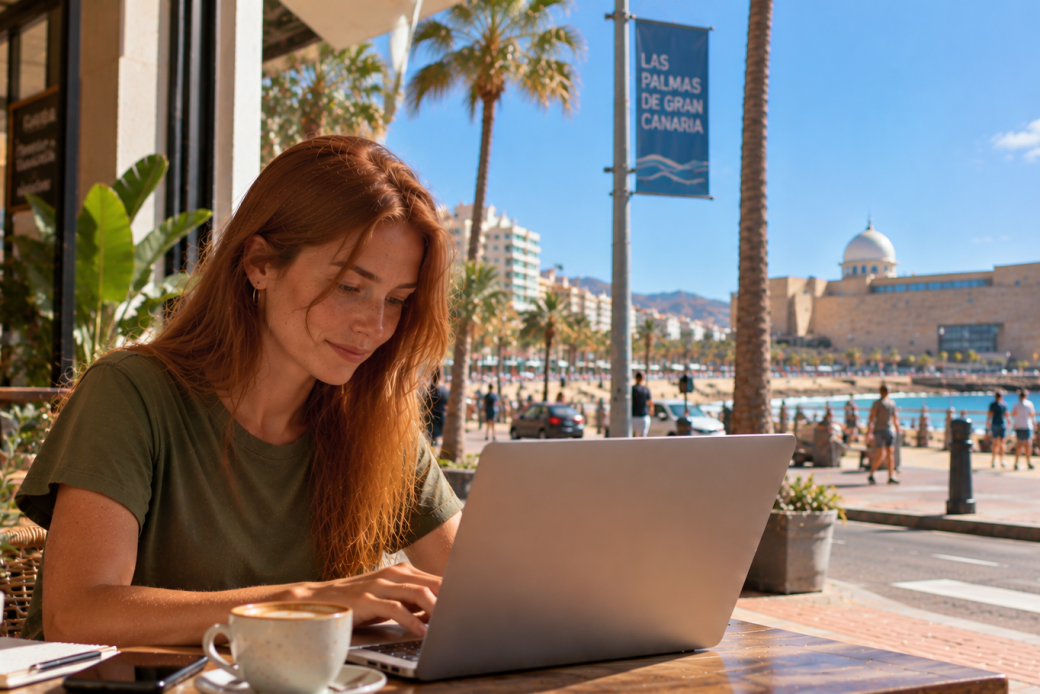
Living in Las Palmas de Gran Canaria means choosing how much of your everyday life you want to keep within walking distance. Guanarteme and Las Canteras suit a beach-first routine; Alcaravaneras and Arenales offer a central middle ground; Vegueta and Triana bring culture and island connections; and Ciudad Alta can open up more space and housing options. For a first stay, Alcaravaneras or Arenales make balanced bases. If the beach is an important part of your routine, start around Guanarteme.
Are you choosing between the sea, a shorter commute or extra room in your budget? This guide compares the best areas to live in Las Palmas de Gran Canaria, their asking rents, everyday feel, transport connections and suitability for remote work.
The broader guide to living in Gran Canaria as a digital nomad compares the island’s main bases, while the guide to the best areas to live in Gran Canaria looks at the island beyond the capital. Here, we move down to the city map so you can choose a neighborhood, home and daily route within Las Palmas.
How Las Palmas is organized: three city bases and a higher-altitude option
Las Palmas does not revolve around one single center. Puerto-Canteras, the central belt and Vegueta-Triana support different kinds of weeks, while the upper and outer neighborhoods widen your options when space, budget or a quieter setting matter more.
| City base | Key neighborhoods | What you can keep close | What may require a trip |
| North and beach | Guanarteme, Las Canteras, Santa Catalina and La Isleta | Beach, sports, restaurants, social life and everyday services | San Telmo, Vegueta and the south side of the city |
| Central belt | Alcaravaneras, Ciudad Jardín and Arenales | Shopping, an urban beach, north–south connections and daily errands | It depends on whether your plans center on Las Canteras or Triana |
| Historic core | Triana and Vegueta | Culture, shopping, restaurants and San Telmo bus station | Las Canteras and La Cícer |
| Upper city and west | Schamann, Escaleritas, Siete Palmas and Tamaraceite | Residential housing, neighborhood stores and road access | The coast, historic center or both, depending on the address |
The decision is not only about counting miles. In a long city with hills and changing elevations, a home that looks close on a map can involve more transfers or slopes than one that is slightly farther away but connected by a direct route.
How much does it cost to rent in Las Palmas de Gran Canaria?
The Idealista rental price report for Las Palmas de Gran Canaria placed the city’s average asking rent at €14.6 per m² in September 2026. The difference between districts helps show where housing demand is concentrated, although it should always be combined with the details of the specific home you are considering.
| Reference district | Asking rent | Approximate calculation for 50 m²* | Neighborhoods it helps contextualize |
| Puerto-Canteras | €17.0/m² | €850 | Guanarteme, Las Canteras, Santa Catalina and La Isleta |
| Centro | €13.9/m² | €695 | Alcaravaneras, Ciudad Jardín and Arenales |
| Vegueta-Triana | €12.8/m² | €640 | Vegueta and Triana |
| Ciudad Alta | €12.5/m² | €625 | Schamann, Escaleritas and Siete Palmas |
| Carretera del Centro-Cono Sur | €12.4/m² | €620 | Neighborhoods along the southern corridor and routes toward the interior |
| Tamaraceite-San Lorenzo | €11.4/m² | €570 | Tamaraceite, San Lorenzo and the surrounding area |
*The third column is a calculation for comparing districts, not a promised rent for a specific apartment. Studios and smaller homes often have a different price per square meter, while condition, furniture and contract length can also change the final amount.
A monthly budget you can use for planning
As a practical planning range, allow €950–1,450 per month if you share a home and €1,350–2,050 if you live alone. The upper end fits more comfortably with furnished housing, frequent coworking and a fuller social calendar. The lower end is more achievable with a favorable residential contract and careful control of additional costs.
These ranges do not include a deposit, moving costs, initial equipment or occasional car rental. The property figures were reviewed on October 6, 2026, using September as the latest complete month.
Residential and temporary rentals follow different pricing patterns
Price-per-square-meter reports describe residential listings and exclude vacation and temporary rentals. If you need a furnished apartment for one to six months, you are also paying for flexibility, furniture and included services. For that reason, the district average should not be applied directly to a seasonal apartment.
Before comparing listings, separate three figures: rent, utilities and move-in costs. Ask what the advertised price includes, what deposit is required, how the length of the stay is documented and which conditions apply when the deposit is returned.
What really changes between neighborhoods in Las Palmas?
Neighborhood names give you a useful starting point, but the exact street and building shape the experience. These are the differences that matter most when you plan to work from home and live in the city for several months.
Guanarteme, Las Canteras and La Isleta
Guanarteme brings La Cícer, the promenade and a visible social scene close to home. Las Canteras lets you add the beach and outdoor exercise to your routine without planning a separate trip. Santa Catalina adds urban connections, while La Isleta offers a more local neighborhood feel and access to El Confital.
The micro-area matters. Check the real distance to the promenade, how active the street feels, the ventilation and the slope if you are looking at the upper part of La Isleta. Expanding your search a few streets inland can keep many of the north’s advantages without paying only for a first-line address.
Alcaravaneras, Ciudad Jardín and Arenales
This central belt gives you a way to stay between the beach-oriented north and the historic south. Alcaravaneras puts Mesa y López and an urban beach nearby; Ciudad Jardín offers a more residential setting; and Arenales connects the two sides of the city conveniently.
It is a practical base if your plans are spread across Las Palmas. Before booking, identify the bus stop or route you would actually use. Living in the geographic center does not automatically mean having a direct connection to every destination.
Triana and Vegueta
Triana concentrates shopping, restaurants and daytime activity. Vegueta adds heritage, plazas, markets and cultural plans. Being close to San Telmo makes it easier to reach the airport and travel around the island without relying on a car every day.
These areas fit you if you want culture and restaurants to be part of your everyday surroundings. Las Canteras remains accessible, but the beach will feel more like a destination within the city than an immediate extension of your neighborhood.
Schamann, Escaleritas, Siete Palmas and Tamaraceite
The upper and western neighborhoods widen your housing search and show lower asking-rent references than Puerto-Canteras. Schamann and Escaleritas retain everyday local stores; Siete Palmas brings together services and road connections; and Tamaraceite can offer more space.
Here, the decision depends less on the postcard view and more on mobility. Check bus frequency, slopes and how often you would need to go down to the coast or historic center.
Try three routes before signing a lease
A viewing shows you the apartment, but it cannot show you whether the address supports your real routine. Walk or travel these three routes at the times you would use them and note the door-to-door duration, including waiting time and slopes.
- Work route: From home to the alternative workspace you would use for focused work, an important meeting or a backup connection.
- Everyday route: To the grocery store, gym, beach or activity you expect to repeat several times a week.
- Getting-out route: To Santa Catalina or San Telmo, depending on which station you would use for the airport or island trips.
If two of the three routes take more effort than you would like, compare another address before making a decision. This exercise helps you compare specific homes rather than relying only on general impressions of a neighborhood.
What to check in a Las Palmas home if you work remotely
For a comfortable workday, the building and room matter as much as the neighborhood. Ask for clear answers and practical proof before paying a reservation.
| Check | What to ask or test | Why it matters |
| Internet | Test the speed in the room and locate the router | Fiber available on the street does not guarantee the same coverage inside the home |
| Ventilation | Ask about orientation, visible humidity and airflow | Homes close to the ocean benefit from good air circulation |
| Noise | Visit during your usual call hours and later in the day | Activity can change between streets and floors in the same neighborhood |
| Natural light | Check the window and the actual light on the desk | An interior room may be comfortable for sleeping but less suitable for daily work |
| Ergonomics | Check the desk, chair, outlets and equipment space | A decorative table is not always ready for a full workday |
| Access | Check the elevator, stairs and slope to the entrance | Elevation changes can affect the comfort of some neighborhoods |
| Lease terms | Ask about duration, utilities, deposit and inventory | It keeps offers with different conditions easy to compare |
The Canary Islands are one hour behind mainland Spain and Central Europe. If your team works from Madrid or Barcelona, a meeting scheduled for 9:00 a.m. will start at 8:00 a.m. in Las Palmas. Check that the home, natural light and household routine support that start time.
How to get around Las Palmas from each area
A car is optional in much of the city, but the most convenient combination changes by neighborhood. In Puerto-Canteras and the historic core, walking covers many everyday trips. The central belt makes it easy to combine walking with city buses, while Ciudad Alta and Tamaraceite may depend more on a direct bus line or a car.
The official Guaguas Municipales fare page lists a €1.40 single ticket and a €0.42 journey with the Bono Guagua contactless pass, which has a minimum €8.50 top-up at the time of review. Check the routes near the exact home rather than looking only at the closest stop.
If you enjoy cycling, Sitycleta can be useful when both your starting point and destination are close to its stations. At the time of review, the monthly pass costs €3.34 and the annual pass €40, with the first 30 minutes of each pedal-bike rental included. For the rest of Gran Canaria, you can combine intercity buses with occasional car rentals.
From choosing a neighborhood to building a local routine
Your address determines where you sleep and work, but the people and places you return to shape the experience of living there. Through the WanderPad app, you can create a profile, join communities and chats and connect with other digital nomads and remote professionals in the city.
The WanderPad Spaces network can also help you find work-friendly places and turn them into regular points in your week. If you are still comparing Las Palmas with other destinations, the wider guide to the best places to live in Spain while working remotely uses the same questions around rent, lifestyle, connectivity and daily routine.
Frequently asked questions about living in Las Palmas
What is the best area in Las Palmas for remote work?
Guanarteme is one of the most complete choices if you want the beach, services and an international community nearby. Alcaravaneras and Arenales can feel more balanced if your plans take you to both the north and Vegueta-Triana. The strongest address is the one that makes your recurring routes easy.
Is it better to live in Las Canteras or Guanarteme?
Las Canteras puts the promenade and beach right outside your routine. Guanarteme keeps that proximity, especially around La Cícer, while giving you more streets to compare inland. Look at noise, ventilation, workspace, natural light and rent for each home rather than choosing only by the neighborhood name.
Which areas have lower rents than Puerto-Canteras?
The September 2026 references place Centro, Vegueta-Triana, Ciudad Alta, Carretera del Centro-Cono Sur and Tamaraceite-San Lorenzo below Puerto-Canteras. This does not mean every apartment will cost less, but it gives you a useful framework for widening your search.
Can you live in Las Palmas without a car?
Yes. Guanarteme, Las Canteras, Alcaravaneras, Arenales, Triana and Vegueta make it possible to combine many daily trips on foot with buses or bikes. In upper or outer neighborhoods, check the exact connection before deciding whether you want to rely on a car.
What should I check in an apartment near the beach?
Check ventilation, signs of humidity, orientation, noise, window seals and Wi-Fi coverage at your workspace. Ask who handles maintenance and utilities during the lease. The closest apartment to the water is not automatically the most comfortable one for a remote-work routine.
Choose the Las Palmas week you want to repeat
The best neighborhood for living in Las Palmas is the one that supports the version of the city you want to enjoy regularly. Start with your budget, identify the places you will visit each week and then compare homes by light, internet, noise, transport and the everyday atmosphere you want around you.
Would you rather finish work with a walk along Las Canteras, a coffee in Triana, an easy connection across the city or more space in a higher neighborhood? Once you know that answer, the map becomes much easier to read.
The WanderPad English blog brings together more destination guides and practical ideas for remote workers building a routine in Spain. Use those resources alongside a short first stay, and let the places you naturally return to guide your final choice.