
Remote work mobility depends less on your job than on the destination and the routine you want to build there. If you are spending a few weeks or months in another city, you may not need to choose one form of transportation for the entire stay.
In a large or medium-sized city, walking and public transportation can often cover your daily routine. A bike can make short trips more enjoyable, while a car can remain available for excursions, regional travel or places that are not as well connected.
The key is to think about your actual week before choosing where to live. A home with slightly lower rent may be less convenient if you then need a car, frequent taxis or a long journey every time you go to work, train or meet someone.
How to choose transportation around your remote-work routine
Working remotely does not necessarily mean staying at home. You might work from your apartment four days a week and spend Fridays at a coworking space. Your gym, supermarket, social plans and favorite outdoor spots may all be in different parts of the city.
Before deciding between a car, public transportation or a bike, identify your three most common weekly routes. Then compare each option from door to door, including walking time, waiting, transfers, parking and the final stretch.
| Your situation | Main option | Useful alternative |
| Most of your week happens within a compact area | Walking and public transportation | Bike or occasional taxi |
| You regularly travel between 2 and 8 km | Bike | Public transportation |
| You live outside the urban center and need several transfers | Car or car plus train | Public transportation on selected days |
| You move around when public transportation is less frequent | Car | Taxi or a vehicle rented by the day |
| You mainly want to explore nearby areas on weekends | Public transportation | Occasional rental car |
Do not focus only on the number of kilometers. An eight-kilometer journey on a direct metro line may feel easier than a four-kilometer route that involves walking, waiting and two transfers.
As a first test, check how long it would take to travel from a possible home to:
- The place where you would work outside your apartment.
- The area where you expect to spend most of your social time.
- An important station or transport connection.
If at least two of those routes take around 30–45 minutes door to door without too many transfers, living without a car may fit your routine very well.
Do you need a car if you work remotely?
The answer depends much more on your destination and weekly routine than on the fact that you work online. A car can be useful, but it is not automatically part of a remote worker’s setup.
When a car may fit your routine
Consider a car if:
- You regularly need to reach places with limited public transportation.
- You live outside the main urban area.
- Your working or personal schedule falls outside normal transport hours.
- You frequently carry equipment, sports gear or other materials.
- You want to explore different areas several times a week.
- The time you save clearly adds value to your stay.
Compare the full cost rather than only the rental fee or monthly payment. Include fuel or charging, parking, tolls, maintenance, insurance and any garage costs. A car that looks convenient at first can have a very different monthly impact once you add everything you will actually use.
What if you only need a car occasionally?
If you need a car for an excursion, a large grocery shop or one particular weekend, renting only for those days may be the most practical option. You keep the freedom to travel when it adds value without paying for a vehicle that spends most of the week parked.
This distinction is especially useful on islands. When living in Tenerife as a digital nomad, your mobility needs may be very different depending on whether you choose the metropolitan area, a coastal town or a more remote base.
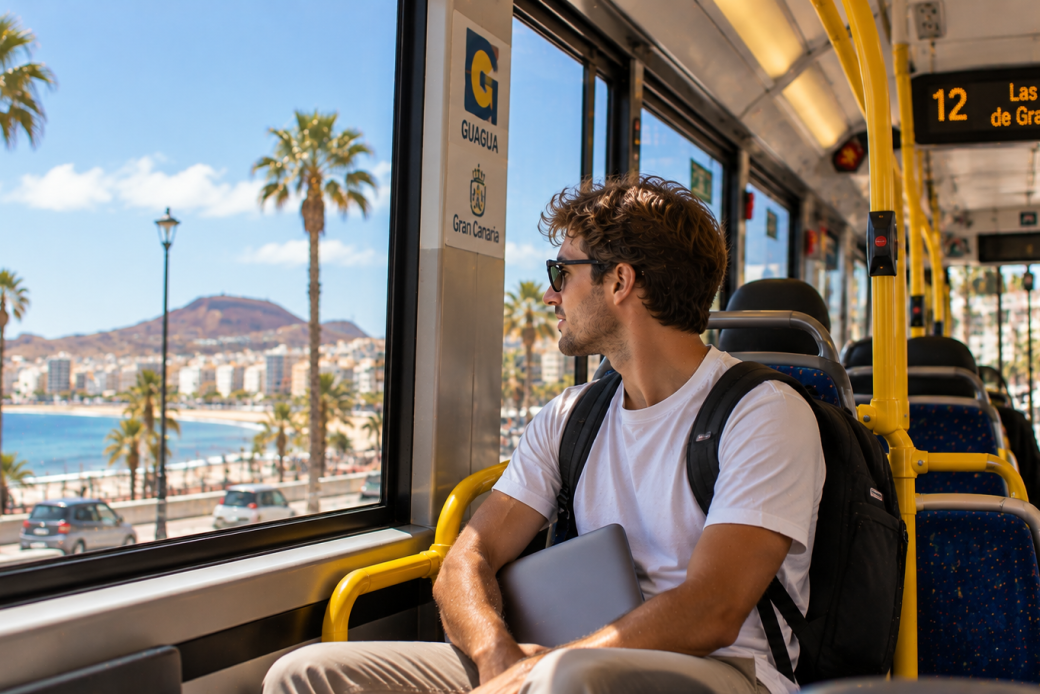
The same applies when living in Gran Canaria as a digital nomad. From Las Palmas, you can cover a large part of your daily routine on foot or by bus, while other parts of the island may make a car particularly useful for regular exploration.
Living without a car: when it works well
The more compact and connected a city is, the easier it becomes to create a comfortable routine without owning a vehicle. The best choice depends on how often you travel, where you live and the transport network available at your destination.
The INE’s 2025 quality-of-life and mobility data illustrates this difference across Spain. Public transportation was the main mode for 48.8% of people living in municipalities with more than 500,000 residents, compared with 10.9% in municipalities with fewer than 10,000 residents. In smaller municipalities, the car played a much larger role.
Before buying a monthly pass, think about how often you will really use the network. A pass is usually more useful when your trips are frequent and predictable.
| How often you use transportation | What to compare |
| Practically every day | Monthly pass |
| Two or three days per week | Multi-trip pass |
| Occasionally | Pay-as-you-go tickets |
| Frequently between cities | Rail or integrated regional pass |
Always check the zones included, transfers, airport connections and activation date. Two passes with similar prices can support completely different routines.
If you expect to travel regularly between cities, the Spanish government’s Abono Único may also be relevant. The 2026 pass costs €60 for 30 days, while the young and children’s version costs €30 for eligible users. It applies to certain state-operated regional bus and rail services, so it does not automatically replace local transportation in your destination.
Getting around by bike: when it makes sense
A bike can be an excellent option for remote workers whose regular routes are relatively short. A distance of 2–8 kilometers each way can be practical, but the number alone does not tell you whether a route will feel comfortable.
Five kilometers on a mostly flat, continuous path can be easier than three kilometers with heavy traffic, steep sections or difficult crossings. Before making a bike part of every workday, check the route, weather, parking and your backup option.
Test the route before relying on it
Ride or walk the actual route at the time you would normally use it. Check where you can leave the bike at home and at your workspace, and consider whether you will feel comfortable using the route after dark.
It also helps to have a second option. The bike may work beautifully on most days, while public transportation or an occasional taxi can make the rest of the week more flexible. Add lights, a quality lock and basic maintenance to your budget if you buy or rent a bike for several months.
What about an electric scooter?
Electric scooters and other personal mobility vehicles can cover similar distances, but they follow their own rules. Since October 1, 2026, Spain’s updated traffic regulations include a minimum age of 15, mandatory helmets and reflective clothing at night or in low visibility for personal mobility vehicles. The Spanish Directorate-General for Traffic also sets new rules for bicycles, including preferred positioning in the center of urban lanes and updated interurban helmet requirements.
Local ordinances may add rules about circulation and parking, so check the regulations in the municipality where you will be staying. The right option is the one that makes your regular routes feel clear, comfortable and easy to repeat.
Combine car, bike and public transportation
During a temporary stay, combining several options is often the simplest approach. You can choose one main form of transportation for everyday life and add another whenever the route or activity calls for it.
| Type of journey | Usual option | Backup option |
| Daily routine | Walking, bike or public transportation | Occasional taxi |
| Coworking or a professional meeting | Public transportation | Bike if the route is comfortable |
| Evening plans | Public transportation | Taxi for the return journey |
| Day trip or excursion | Train or bus | Car rented by the day |
| Luggage or a large purchase | Taxi or car | Delivery when available |
This approach means you do not pay every month for the most expensive option simply because you need it twice. It also gives you more flexibility when your plans change.
Mobility is part of the destination decision. Our guide to the best places to live in Spain lets you compare compact cities, islands and larger urban areas where transportation can shape your experience in very different ways.
Mobility starts before you book your accommodation
This is one of the most useful checks you can make before choosing a home. Open a map and mark the places that are likely to form part of your week: a supermarket, gym, station, workspace and the areas where you expect to spend time with other people.
Then test the routes at the times when you would actually travel. A bus that runs every ten minutes during the day may have a different frequency after dinner. A route that looks quick by car may take longer once you include parking.
Think about the complete cost as well. A home that saves €100 in rent may require an additional transport pass, regular taxis or occasional car rental. Comparing housing and mobility together gives you a much clearer picture of the destination.
WanderPad’s verified workspaces can help you identify potential places to work and see how they relate to your accommodation. That makes it easier to compare a home not only by rent, but also by the routine it enables.
A simple test before deciding how to move around
If you are still choosing between a car, bike or public transportation pass, test each option against one normal week.
- Count your likely journeys. Focus on the trips you expect to repeat, not every trip you could theoretically make.
- Compare the door-to-door time. Include walking, waiting, transfers and parking.
- Turn each option into a monthly figure. Include passes, rentals, fuel, taxis, parking and maintenance.
- Plan for different conditions. Consider what you would do if it rains, you return late or you need to carry something.
- Count how often you genuinely need a car. If the answer is two weekends per month, renting only for those days may be enough.
The best option does not have to be the fastest for one particular journey. It is the one that solves most of your week with a reasonable cost and level of effort.
Build a weekly routine around people and places
Transportation is not only about getting from one address to another. It also affects where you work, how often you return to a place and how easily you build connections in a new city.
The WanderPad app lets you connect with remote professionals and digital nomads through profiles, communities and chats. Knowing where people work, meet and organize activities can help you choose a home that supports the social routine you want as well as your working hours.
Ask yourself: Which places would I like to reach regularly without having to plan every trip from scratch? That answer can help you decide whether living closer to a workspace, station, beach or neighborhood center would make your stay feel easier.
Frequently asked questions about getting around while working remotely
Do I need a car to work remotely from another city?
Not necessarily. In a compact, well-connected city, walking and public transportation can cover most of your routine. A car is more useful in smaller municipalities, peripheral areas, rural destinations or when you travel between regions regularly.
Is it cheaper to live without a car?
It can be, particularly when your accommodation is well connected. Compare public transportation and occasional taxis with the complete cost of a car, including rental or financing, fuel, parking, insurance and maintenance.
What is a reasonable distance to travel by bike?
Around 2–8 kilometers each way can be practical for many people, but the route matters more than the distance alone. Check the slope, traffic, weather, bike lanes, parking and whether you have a comfortable alternative.
How do I know whether a monthly transportation pass is worthwhile?
Estimate how many trips you will make during the month and compare the total with the pass price. Check the zones, transfers, airport connections and activation conditions before choosing it.
What is the best transportation combination for a temporary stay?
In a city, walking and public transportation are often a strong base. You can add a bike for shorter routes and rent a car only when you need to reach places with fewer connections or explore outside the city.